Automating Business Workflows: The Silent ROI of API Integrations
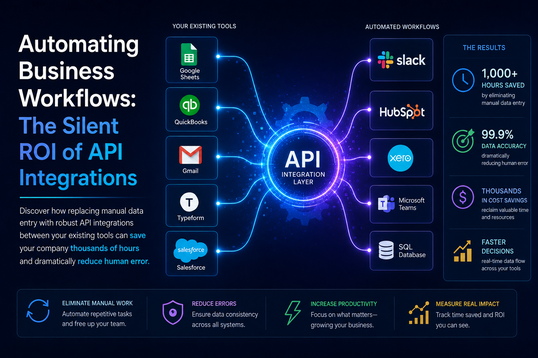
Table of Contents
In the modern enterprise, the biggest bottleneck to scaling isn't a lack of sales leads; it's the operational drag of disconnected systems. The sales team practically lives in Salesforce, the accounting team relies entirely on QuickBooks, operations tracks inventory on Airtable, and customer support manages issues in Zendesk.
When these critical systems don't communicate with each other, humans are forced to become the glue. Highly paid employees spend hours every week downloading CSV files from one platform, massaging the data in Excel, and uploading it to another. This manual synchronization is not only a massive waste of payroll, but it introduces critical human errors that can damage client relationships.
The True Cost of Manual Workflows
Let's run the conservative numbers. If you have just 5 employees spending 1 hour a day copying and pasting data between systems, that amounts to 25 hours a week. At a burdened rate of $40/hour, you are spending $4,000 a month—or almost $50,000 a year—just to move data from point A to point B.
But the true cost of manual workflows is much higher than payroll. What happens when a typo results in an incorrect shipping address for a high-value order? What happens when a hot lead falls through the cracks because a sales rep forgot to manually add them to the CRM drip campaign? The cost of errors dwarfs the cost of labor.
Enter API Automation
An Application Programming Interface (API) allows different software applications to communicate securely, instantly, and reliably. By building custom middleware or utilizing advanced webhooks, we can automate the entire lifecycle of a customer interaction without a human ever touching a keyboard.
A Real-World Example: The E-Commerce Logistics Pipeline
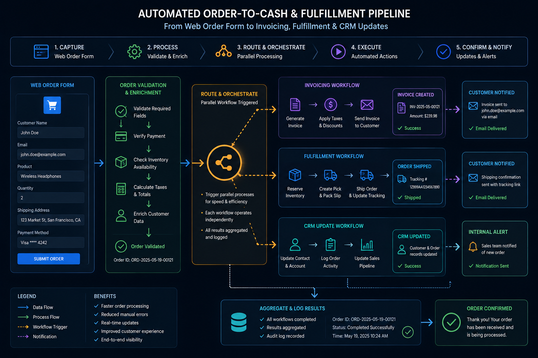
Consider a custom, multi-step workflow we built for a mid-sized B2B logistics client:
- The Trigger: A wholesale customer submits a bulk order on the custom Laravel web application.
- Automation 1 (Warehouse): The website's API instantly pushes the order payload to the warehouse management system (WMS), generating a pick-and-pack list in real-time.
- Automation 2 (Accounting): Simultaneously, a webhook triggers QuickBooks to generate a legally compliant invoice and automatically email a PDF copy to the client's accounting department.
- Automation 3 (CRM): The CRM is updated with the new purchase history. If the order value exceeds $10,000, the API triggers an automated Slack message to the Account Executive to personally call and thank the client.
Custom Integration vs. Zapier
A common question we receive is: "Can't we just use Zapier for this?"
Tools like Zapier and Make.com are fantastic for simple, two-step automation (e.g., "When a Typeform is submitted, send a Slack message"). However, they struggle immensely with complex, multi-step business logic involving loops, conditional formatting, and millions of records. Furthermore, Zapier charges per "task." At scale, routing 100,000 orders a month through Zapier becomes prohibitively expensive.
A custom API integration built natively into your software infrastructure removes these limitations. It provides a robust, lightning-fast, and highly secure data pipeline that scales infinitely without exponentially increasing your monthly SaaS bills.
Stop paying your intelligent employees to act like robots. Automate your workflows, eliminate human error, and free your team to do high-value, creative work that actually grows your business.
Need expert help with this?
Our team at LinkMyTech specializes in building custom digital solutions that drive real results. Let's discuss your project today.