Core Web Vitals and Technical SEO: Why Code Quality Matters
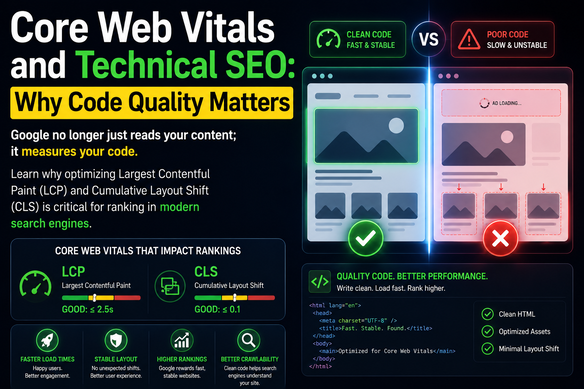
Table of Contents
For over a decade, the SEO industry was straightforward: optimize your keywords, write decent content, and acquire high-authority backlinks. If you did those three things, you ranked. However, the search landscape has shifted drastically. Google has recognized a fundamental truth about the web: a website with incredible content is completely useless if it takes 10 seconds to load on a mobile connection, or if the layout jumps around while the user is trying to read.
Welcome to the era of Core Web Vitals (CWV). Your website's underlying codebase and server architecture are now direct, heavily weighted ranking factors.
The Three Pillars of Core Web Vitals
Google no longer evaluates your website in a vacuum using bots. It collects real-world user metrics (Field Data) via the Google Chrome browser to see exactly how real humans experience your site. The three most critical metrics are:
1. Largest Contentful Paint (LCP)
LCP measures loading performance from the user's perspective. It marks the exact time in the page load timeline when the largest text block or image element (usually the hero banner) is fully rendered and visible on the screen. To provide a good user experience and pass Google's assessment, LCP should occur within 2.5 seconds of when the page first starts loading.
How we fix poor LCP: We upgrade server response times using efficient PHP frameworks like Laravel, utilize edge caching via Cloudflare CDNs, compress images using modern formats like WebP/AVIF, and aggressively eliminate render-blocking CSS and JavaScript.
2. Interaction to Next Paint (INP)
Replacing the old First Input Delay (FID) metric, INP measures the overall responsiveness of a page to user interactions. When a user clicks an "Add to Cart" button, how long does the browser take to visually respond? If your website is bogged down with massive React Javascript bundles or heavy third-party tracking scripts, the browser's main thread will be blocked, causing a frustrating, laggy delay.
How we fix poor INP: We break up long JavaScript tasks using Web Workers, defer non-critical scripts until after the page has loaded, and prioritize lightweight Vanilla JS or Alpine.js over massive frontend frameworks when building marketing sites.
3. Cumulative Layout Shift (CLS)
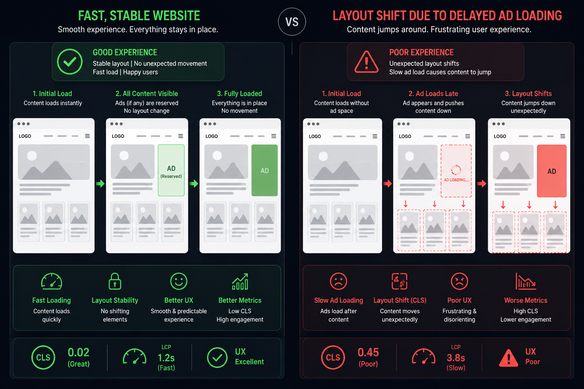
CLS measures visual stability. Have you ever gone to click a link on a news article, and right before you tap it, an advertisement loads and pushes the content down, causing you to accidentally click the ad instead? That frustrating experience is a layout shift, and Google actively penalizes sites that do it.
How we fix poor CLS: We strictly enforce width and height aspect-ratio attributes on all images and video elements so the browser reserves the exact necessary space before the image even loads. We also never insert dynamic content (like pop-ups or banners) above existing content without explicit user interaction.
The Death of Bloated CMS Templates
This algorithmic shift is exactly why cheap, bloated WordPress themes and heavily relied-upon drag-and-drop website builders (like Elementor or Wix) are struggling to rank in competitive niches. They ship immense amounts of unused CSS and JavaScript to the browser just to display a simple page.
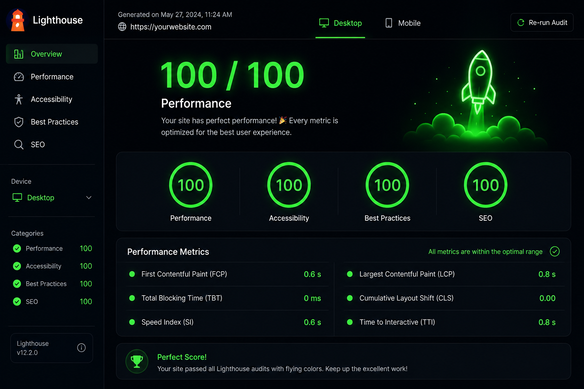
At LinkMyTech, we build custom web applications and marketing sites utilizing lean, compiled code. By controlling the exact output of the Document Object Model (DOM) and managing our assets efficiently via Vite, we routinely deliver 95+ Lighthouse scores for our clients. In a world where every competitor has good content and backlinks, technical SEO is the ultimate tie-breaker.
Need expert help with this?
Our team at LinkMyTech specializes in building custom digital solutions that drive real results. Let's discuss your project today.