Scaling High-Performance Web Platforms: Pitfalls to Avoid
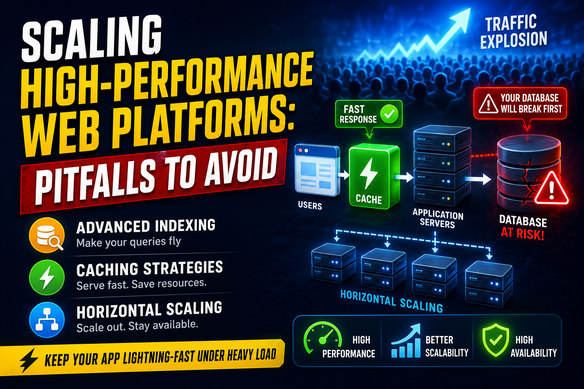
Table of Contents
It is every startup founder's dream to go viral. You launch your new SaaS product, a major influencer tweets about it to millions of followers, and suddenly tens of thousands of concurrent users are flooding your application. But for the engineering team responsible for keeping the servers online, this dream is often a nightmare.
When traffic spikes unexpectedly, bad architectural decisions are brutally exposed. The application slows to a crawl, the database locks up under pressure, and eventually, the web servers crash, resulting in dreaded 502 Bad Gateway or 503 Service Unavailable errors. In this deep dive, we explore exactly what breaks when you scale, and how to prevent it.

The Primary Bottleneck: The Database
In web development, 90% of scaling issues are database issues. The web application servers (running PHP, Node, or Python) are "stateless" and can easily be scaled horizontally—meaning you just spin up 10 more servers behind an AWS Load Balancer. But scaling a stateful relational database like MySQL or PostgreSQL is exponentially harder.
1. Missing Indexes and Sequential Scans
The most common cause of database lockups is missing indexes. If you are querying a `users` table by `email` (e.g., during login) and there is no index on that column, the database engine is forced to scan every single row in the table to find the match. When you have 10,000 users, this sequential scan takes a few milliseconds. When you have 10 million users, it takes seconds and locks the CPU. Adding a simple B-Tree index resolves this instantly.
2. The N+1 Query Problem
Modern Object-Relational Mappers (ORMs) like Laravel's Eloquent make querying databases incredibly easy, but they hide the underlying SQL. This often leads to the N+1 problem. For example, if you load 50 blog posts and then loop through them in your HTML template to display the author's name for each post, the ORM will execute 1 query to get the posts, and then 50 separate queries to get each author. That is 51 database queries for a single page load! Under heavy traffic, this will instantly kill your database. The solution is "Eager Loading," which pulls all the data in just 2 queries.
Implementing a Robust Caching Layer
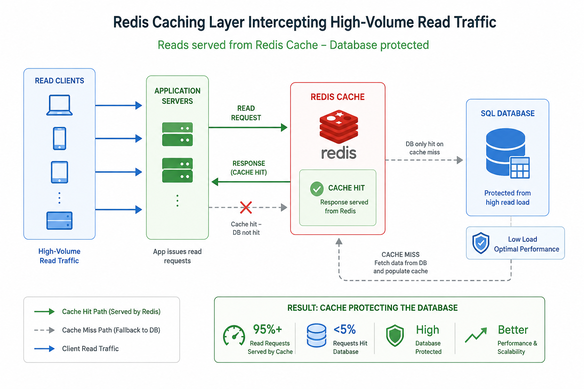
The absolute fastest database query is the one you never actually make. Implementing an in-memory caching layer like Redis or Memcached is non-negotiable for high-traffic platforms.
- Query Caching: Store the results of complex, slow-changing queries (like a global weekly leaderboard or dashboard statistics) in Redis. Serve the data from RAM in 1 millisecond instead of recalculating it on every page load.
- Full Page Caching: If a page is entirely public and looks the same for every user (like a blog post or landing page), cache the fully rendered HTML output. The backend server can return the HTML immediately without ever booting up the application framework or connecting to the database.
Asynchronous Background Processing
Never perform heavy operations during the HTTP request cycle. If a user uploads a video, do not make them wait for the server to process and compress it before returning a response. The HTTP request will time out. Instead, immediately return a "Video is processing" message, and push the heavy compression task to an asynchronous background Queue worker (like Laravel Horizon or AWS SQS).
Conclusion
Scaling requires a proactive, highly technical approach. You cannot wait until the servers are physically on fire to start optimizing your SQL queries. By building with performance in mind from day one—using proper indexing, background queues for heavy tasks, and strategic Redis caching—you can ensure your custom application remains lightning-fast, no matter how many users log in.
Need expert help with this?
Our team at LinkMyTech specializes in building custom digital solutions that drive real results. Let's discuss your project today.
More from Engineering
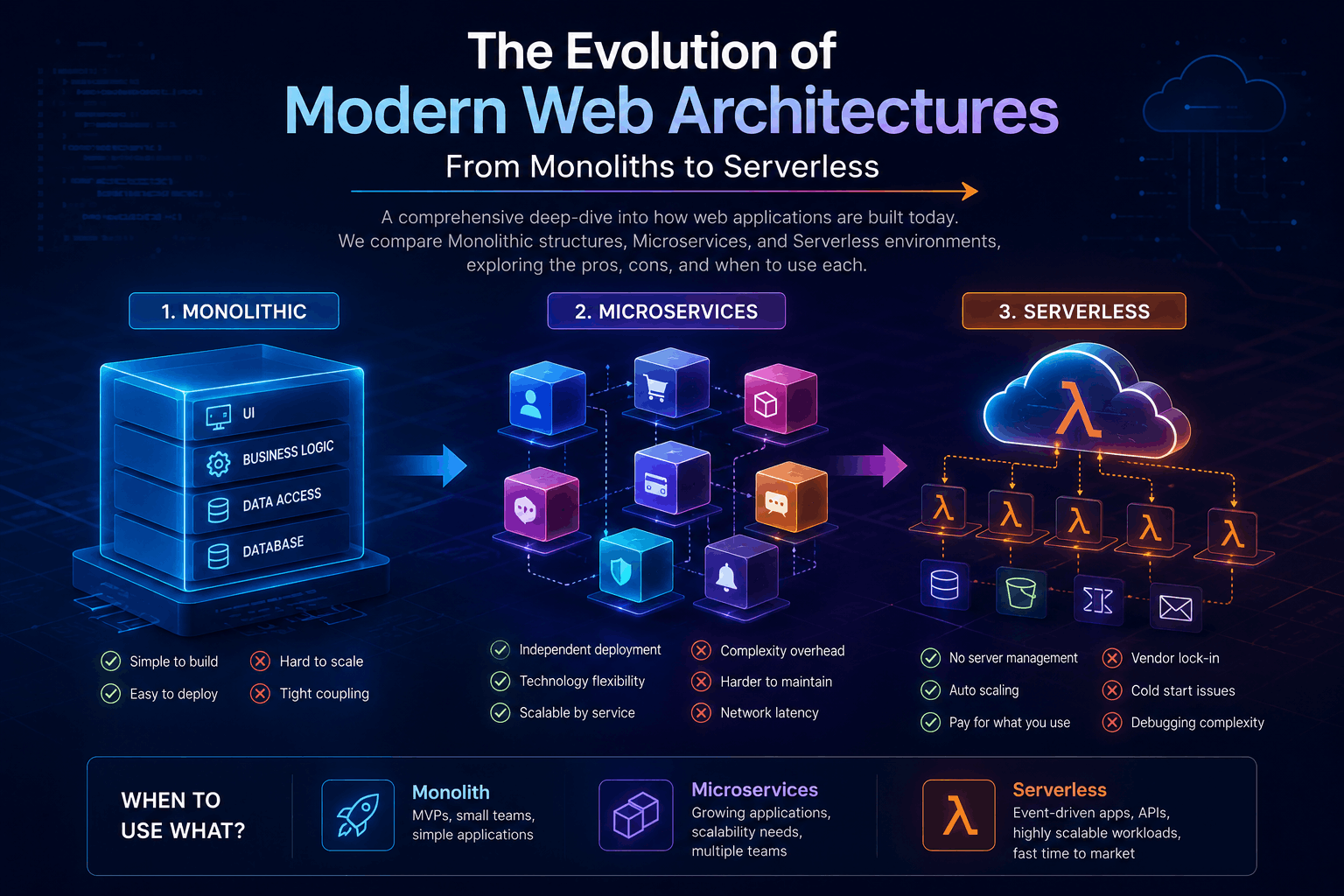
The Evolution of Modern Web Architectures: From Monoliths to Serverless
A comprehensive deep-dive into how web applications are built today. We compare Monolithic structures, Microservices, and Serverless environments, exploring the pros, cons, and when to use each.
Read Article