The Evolution of Modern Web Architectures: From Monoliths to Serverless
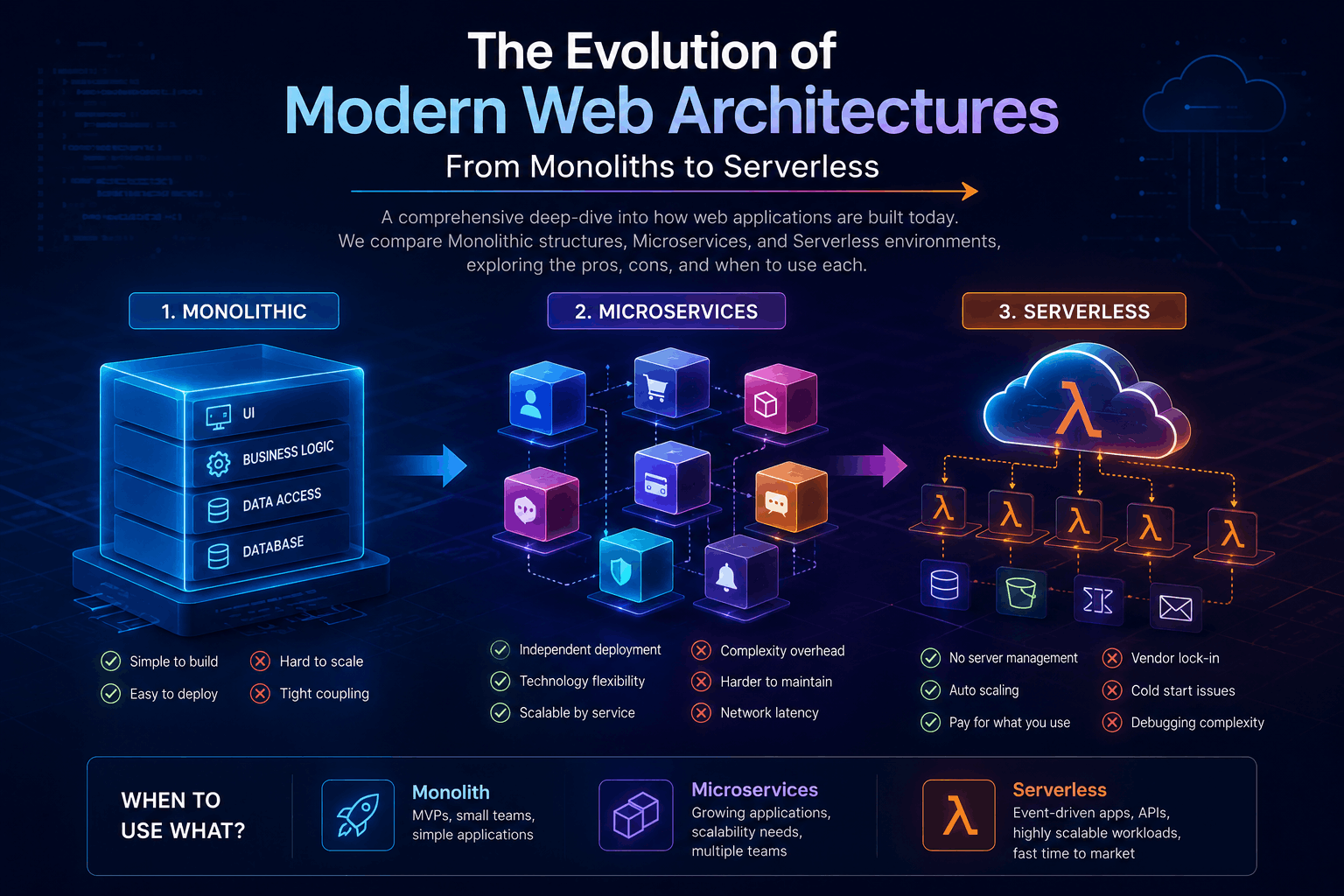
Table of Contents
- 1. The Monolithic Architecture: The Old Reliable
- The Advantages of a Monolith
- The Disadvantages of a Monolith
- 2. Microservices Architecture: The Era of Distribution
- The Advantages of Microservices
- The Disadvantages of Microservices
- 3. The Rise of Serverless Computing
- Conclusion: The LinkMyTech Philosophy
The landscape of web development is in a constant state of flux. What was considered a "best practice" five years ago is often labeled an "anti-pattern" today. For CTOs, technical founders, and lead engineers, choosing the right architecture for your software is the most critical decision you will make. It dictates how fast your team can ship features, how easily the application can scale, and ultimately, your server costs.
In this post, we will dissect the three primary architectural patterns dominating the industry today: Monolithic, Microservices, and Serverless. We will explore the historical context of each, analyze their trade-offs, and provide actionable advice on when to adopt them.
1. The Monolithic Architecture: The Old Reliable
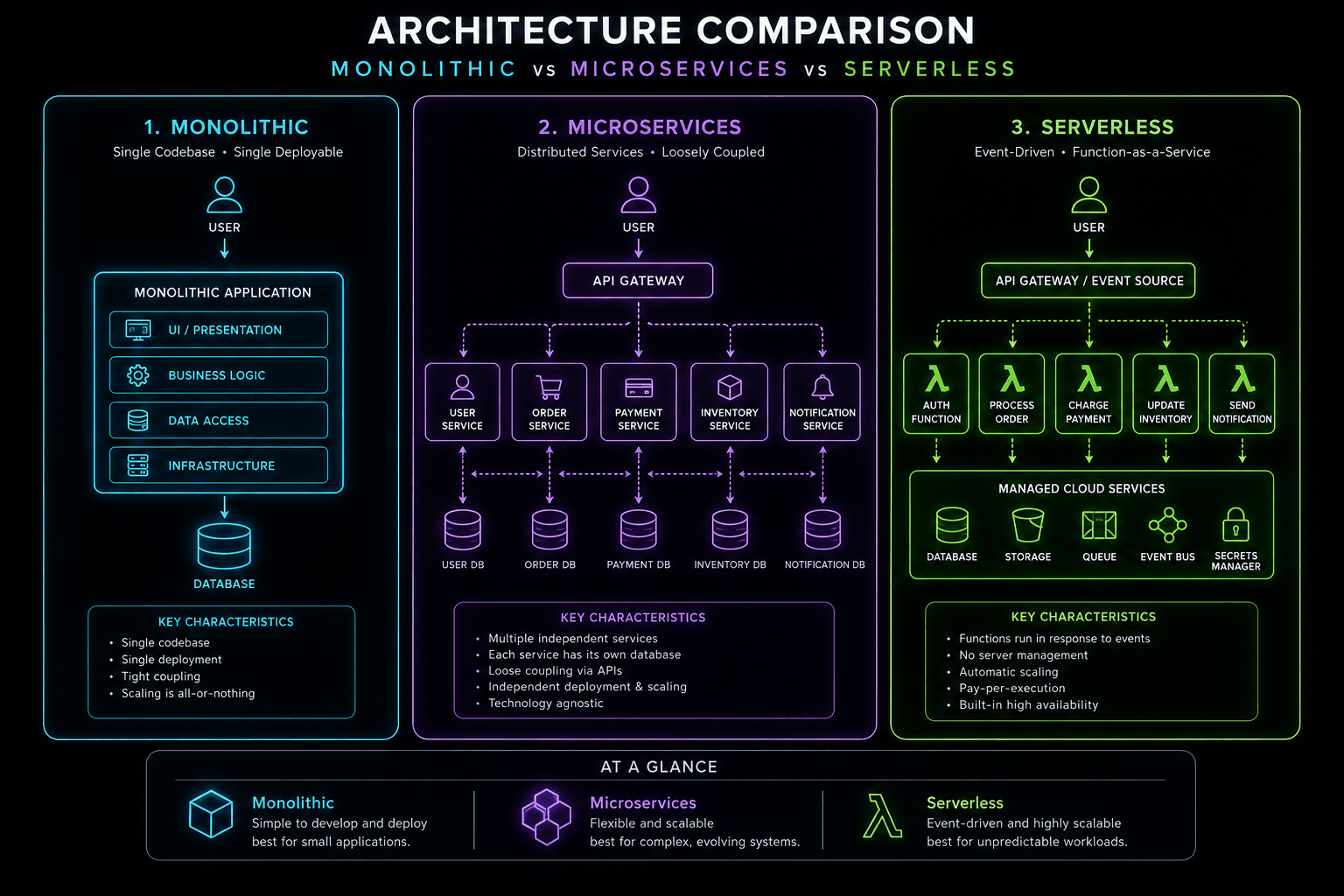
A monolith is the traditional, time-tested way of building applications. The frontend views, backend logic, database abstraction layer, and background jobs are all bundled into a single unified codebase. When you deploy to production, you deploy the entire application at once as a single unit.
"You shouldn't start with microservices. Start with a monolith, keep it modular, and split it up once the monolith becomes a problem." — Martin Fowler
The Advantages of a Monolith
- Simplicity of Development: It is incredibly easy to develop, test, and deploy in the early stages of a project. Any developer can clone the repository, run a single command, and have the entire application running locally.
- Unmatched Performance: Since all components reside on the same server within the same application process, there is zero network latency when the application needs to communicate between different modules. A function call takes nanoseconds.
- Straightforward Debugging: Tracking a request end-to-end is trivial because it all happens within a single application process. Stack traces are complete and understandable.
The Disadvantages of a Monolith
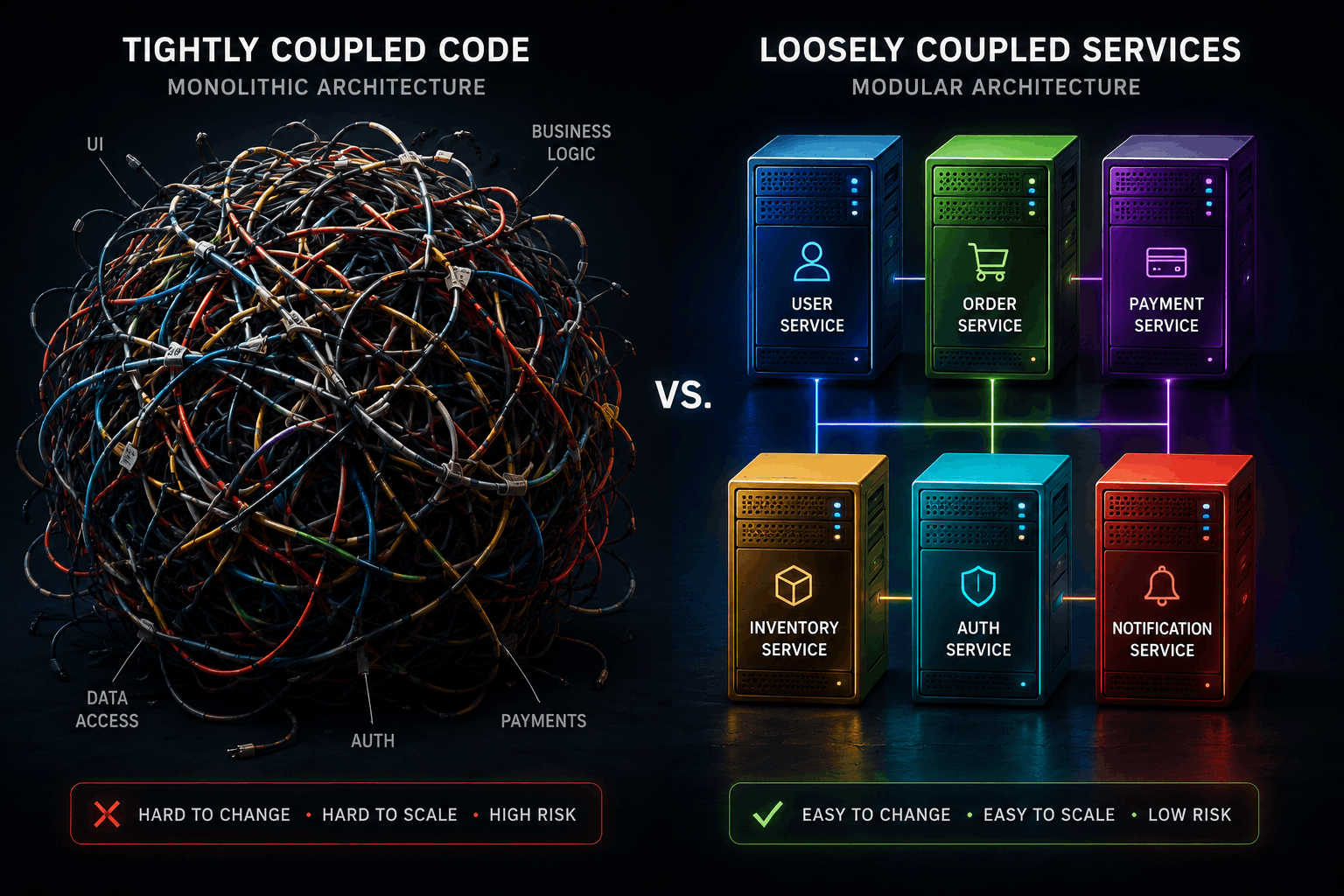
As the application grows from thousands of lines of code to hundreds of thousands, the codebase often devolves into a massive, tangled web of dependencies. A small change in the billing module might accidentally break the user authentication system because they share the same memory space. Furthermore, scaling is inefficient. If your reporting dashboard requires high CPU usage to generate PDFs, you have to scale the entire application, rather than just the reporting module.
2. Microservices Architecture: The Era of Distribution
Microservices emerged to resolve the scaling and organizational issues of the monolith. Instead of one massive application, the system is broken down into dozens (or hundreds) of small, independently deployable services. Each service handles a specific business capability (e.g., User Service, Payment Service, Email Service) and communicates with the others over the network, usually via REST APIs, gRPC, or message brokers like Kafka.
The Advantages of Microservices
- Independent Scaling: If your image processing service needs more RAM, you can provision larger servers exclusively for that service without touching the rest of the application.
- Technological Freedom: The Data Science team can write the recommendation engine in Python, while the Core Backend team writes the payment processor in Go. They just communicate via APIs.
- Fault Isolation: If the email notification service crashes, it doesn't bring down the entire checkout process. The system degrades gracefully.
The Disadvantages of Microservices
While Microservices sound perfect on paper, they introduce immense operational complexity. You now have to manage distributed databases, handle network failures between services, deal with eventual consistency, and implement complex orchestration systems like Kubernetes. For small teams, microservices are often a premature optimization that slows product development to a crawl.
3. The Rise of Serverless Computing
Serverless architecture represents the ultimate abstraction. Rather than managing servers, containers, or application processes, developers write isolated functions (e.g., AWS Lambda, Google Cloud Functions) that execute only in response to specific events (like an HTTP request from an API Gateway or a file being uploaded to S3).
You only pay for the exact milliseconds your code is actively running. For unpredictable workloads or startups needing to move incredibly fast without hiring a dedicated DevOps engineer, Serverless is revolutionary. However, it introduces challenges like "cold starts" (a delay when a function hasn't been executed recently and needs to boot up) and severe vendor lock-in to cloud providers like AWS.
Conclusion: The LinkMyTech Philosophy
At LinkMyTech, our architectural philosophy is pragmatic: Start with a Modular Monolith.
Unless you are operating at the scale of Netflix or Uber on day one, the operational overhead of microservices will stifle your momentum. We build well-structured, modular monoliths using robust frameworks like Laravel. By strictly enforcing boundaries between domains (Billing, CRM, Analytics) within the same codebase, we reap all the benefits of a monolith. When a specific domain eventually becomes a bottleneck, we extract it into its own microservice cleanly.
Need expert help with this?
Our team at LinkMyTech specializes in building custom digital solutions that drive real results. Let's discuss your project today.
More from Engineering
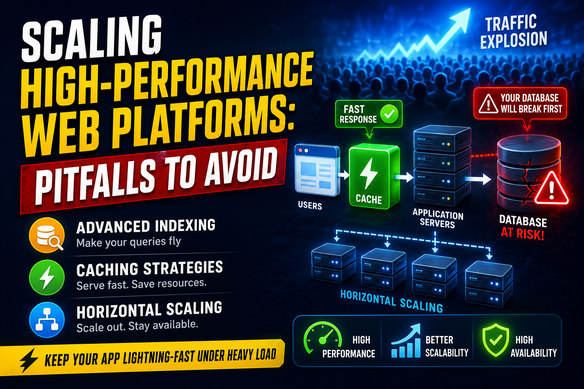
Scaling High-Performance Web Platforms: Pitfalls to Avoid
When your user base explodes overnight, your database will be the first thing to break. We cover advanced indexing, caching strategies, and horizontal scaling techniques to keep your app lightning-fast under heavy load.
Read Article